
An under-sink reverse osmosis system in Peoria costs $300–$1,200 installed. RO removes the dissolved solids other systems leave behind — including the trace arsenic in the city's 2025 report — for drinking water most people can't tell from bottled.
What RO removes, how it fits with a softener, and honest numbers on waste water and maintenance.
Why RO is the Arizona standard for drinking water
Desert surface water is mineral-dense: the city's report shows sodium averaging 70 mg/L, sulfate 135, and total dissolved solids to match. All within standards — and all of it is what you taste. A five-stage RO unit under the kitchen sink strips dissolved solids to a fraction of tap levels, feeding the faucet, the ice maker, and the coffee machine that finally stops scaling.
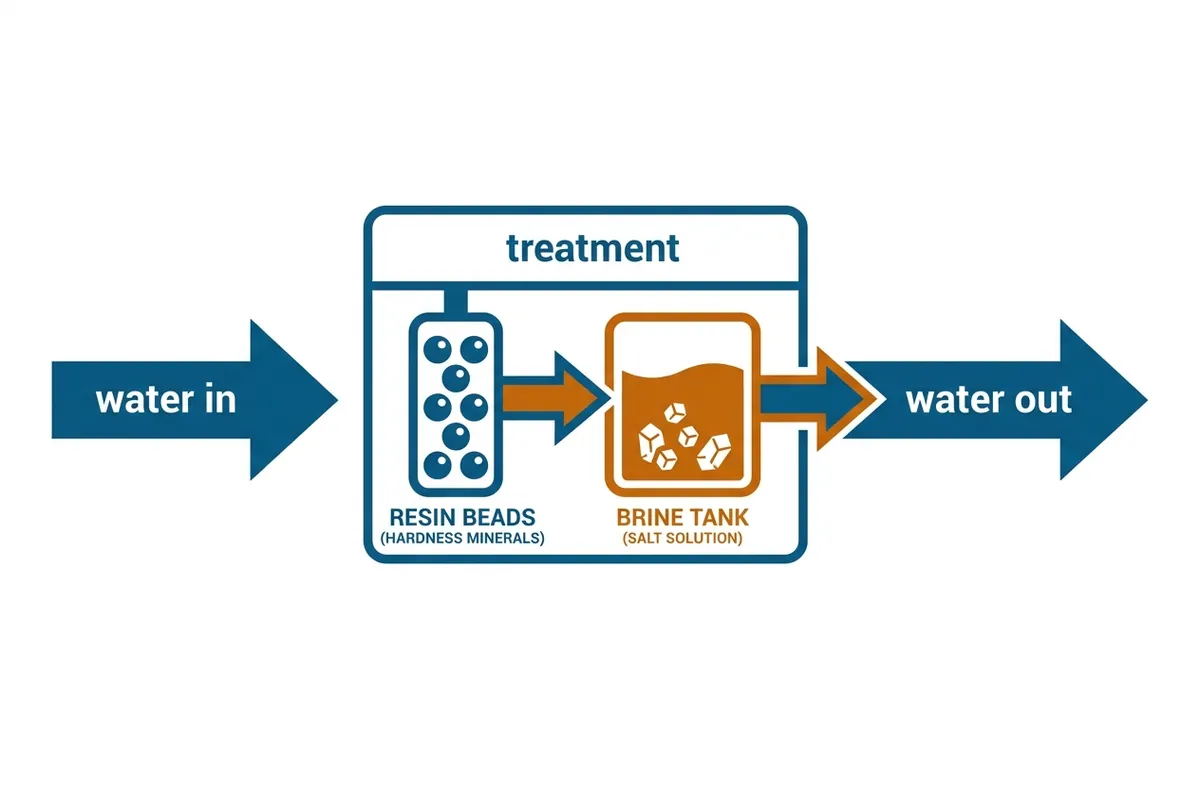
Softener + RO: the standard West Valley stack
They're partners, not competitors. The softener protects the whole house and the RO membrane itself (hard water shortens membrane life measurably); the RO polishes the two or three gallons a day you actually drink. Homes on the softener-plus-RO stack replace membranes about half as often as unsoftened homes.
What's actually dissolved in Peoria tap water?
The city's 2025 report puts numbers on what you taste: sodium averaging 70 mg/L (ranging to 160), sulfate averaging 135 (ranging to 236), and alkalinity around 131. All of it within standards; all of it flavor. An RO membrane rejects the large majority of those dissolved solids, which is why the before-and-after taste difference is bigger here than in most of the country — there's simply more dissolved material to remove.
| Dissolved (city 2025 report) | Average | Range |
|---|---|---|
| Sodium | 70 mg/L | 36–160 |
| Sulfate | 135 mg/L | 34–236 |
| Arsenic | 4.1 µg/L | ND–7.2 (limit 10) |
Do you need RO if you already have a softener?
For drinking water, usually yes — they do different jobs. A softener protects the whole house from scale but leaves dissolved solids (and adds a trace of sodium); RO removes both at the one tap that matters for drinking and cooking. The reverse is also true: RO alone can't protect your water heater. In practice the question isn't either/or — it's which one first, and that depends on whether your bigger complaint today is scale or taste. We'll tell you plainly at the estimate, with your tap numbers in hand.
How long does an RO system last?
The hardware itself — housing, tank, faucet — routinely runs fifteen years and more. What wears are the consumables, on a rhythm you can plan around: sediment and carbon pre-filters yearly, the post-filter with them, and the membrane every three to five years depending on feed water. Homes where the RO runs on softened water sit at the long end of every one of those intervals, because hardness is what fouls membranes early. Budget-wise that works out to roughly the cost of a case of bottled water per month — for water at every glass, without the plastic.
Signs your existing RO needs service
- Slow faucet flow — a filling storage tank or clogged pre-filter
- Flat or "off" taste returning — the membrane or post-filter is spent
- Constant drain trickle — a stuck shut-off valve wasting water
- Cloudy ice — dissolved solids sneaking through a tired membrane
Any of these is a service visit, not a replacement — membranes and filters are the point of the design. We service RO units we didn't install, too.
Frequently asked questions
Does Peoria water have arsenic?
The city's 2025 report shows arsenic averaging 4.1 parts per billion — below the federal limit of 10, and legal to serve. Reverse osmosis removes the majority of what remains, which is why it's the standard drinking-water polish in Arizona.
Does RO remove the sodium a softener adds?
RO removes the sodium a softener adds. Softening swaps hardness for a small amount of sodium; an RO unit at the kitchen sink takes that back out of the water you actually drink and cook with.
How much water does RO waste?
Modern units run roughly 1:1 to 4:1 depending on model and pressure. At kitchen-tap volumes that's a few extra gallons a day — not a meaningful number even under desert water rates.
What maintenance does it need?
Pre and post filters yearly, the membrane every 3-5 years. We service what we install, or set you up to do the swaps yourself in ten minutes.
Can you install RO and a softener together?
We can install RO and a softener together, and it's the most common package we install — the softener protects the house and the RO membrane, the RO polishes the drinking water. One visit, one shared quote.
Get a free Peoria estimate
Tell us what you're seeing at your fixtures and we'll recommend a system sized to your home. We reply the same business day.